

Why an IT Roadmap Matters More Than Any Single Tool in 2026
Why leaders are re‑thinking “buying tools” and focusing on technology direction instead.
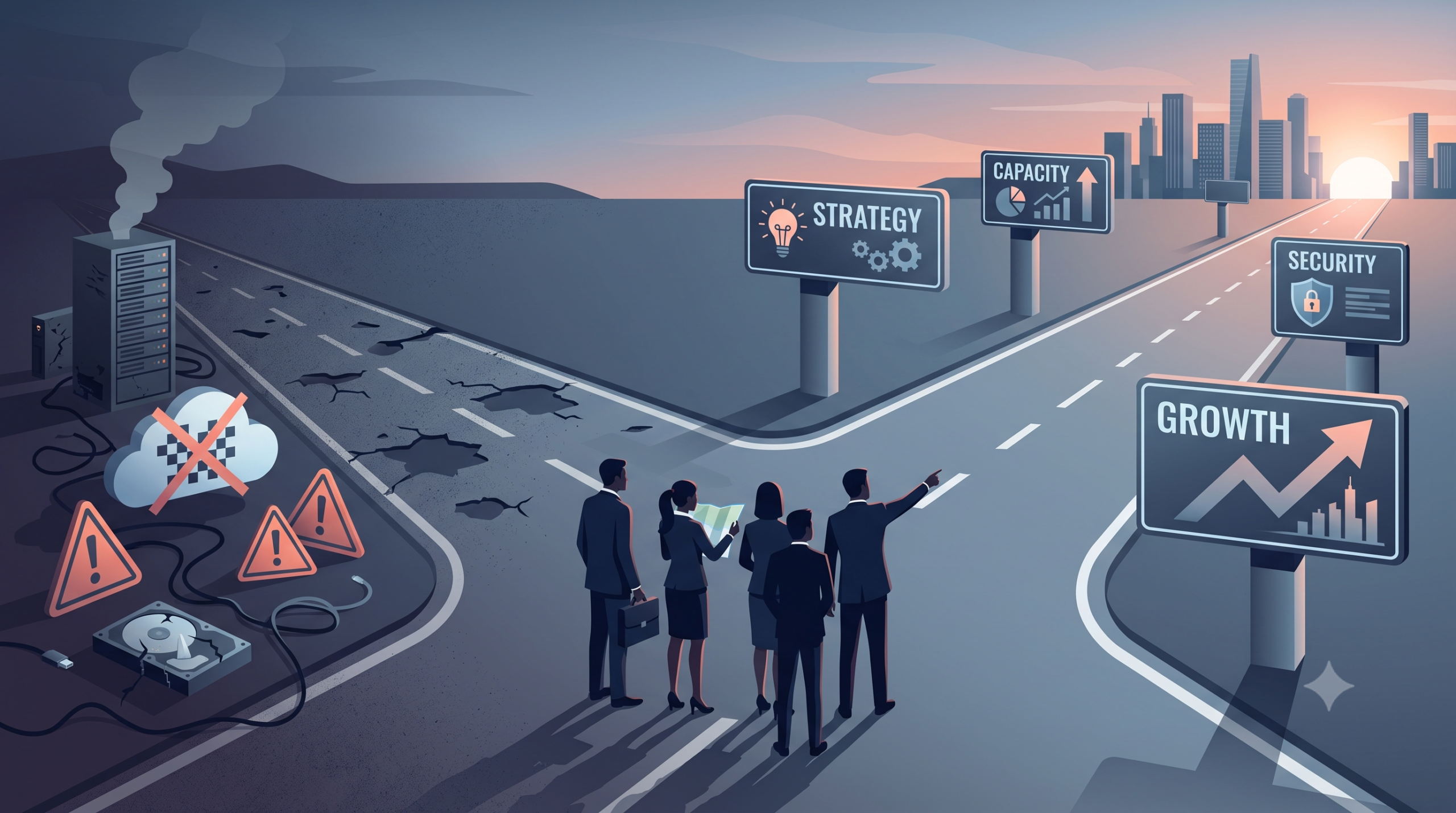
The Silent Problem: Technology Without Direction
Multiple overlapping tools performing similar functions.
Difficulty explaining why a system exists and what value it adds.
Projects stalling because key dependencies are unclear
A real‑world example: Growth Slowed by Invisible Complexity
Imagine a mid‑sized services company that has grown quickly over the last three years. Each business unit has made reasonable technology choices in isolation:
Most organisations have accumulated technology over time: a mix of on‑premises systems, cloud platforms, and SaaS tools adopted to solve immediate problems. Yet many leadership teams struggle to answer a simple question: how do all of these investments move us towards our business goals?
Without a clear direction, IT decisions are made reactively. A tool is bought when a project gets stuck; infrastructure is upgraded only after a failure; security controls are added in response to the latest incident. Over months and years, this creates invisible complexity and technical debt. When the answer is unclear, three things happen:
One team selected its own CRM platform.
Another adopted a cloud‑based project management tool.
File storage is split between ageing servers and various cloud drives.
Nothing appears broken day‑to‑day. The problems surface when the company tries to onboard a major new client and needs consistent reporting across departments. Suddenly, data reconciliation becomes manual, timelines slip, and stakeholders lose confidence in the systems.
“The issue wasn’t a single outage. It was the absence of a shared direction for technology.”
What an effective IT roadmap actually contains
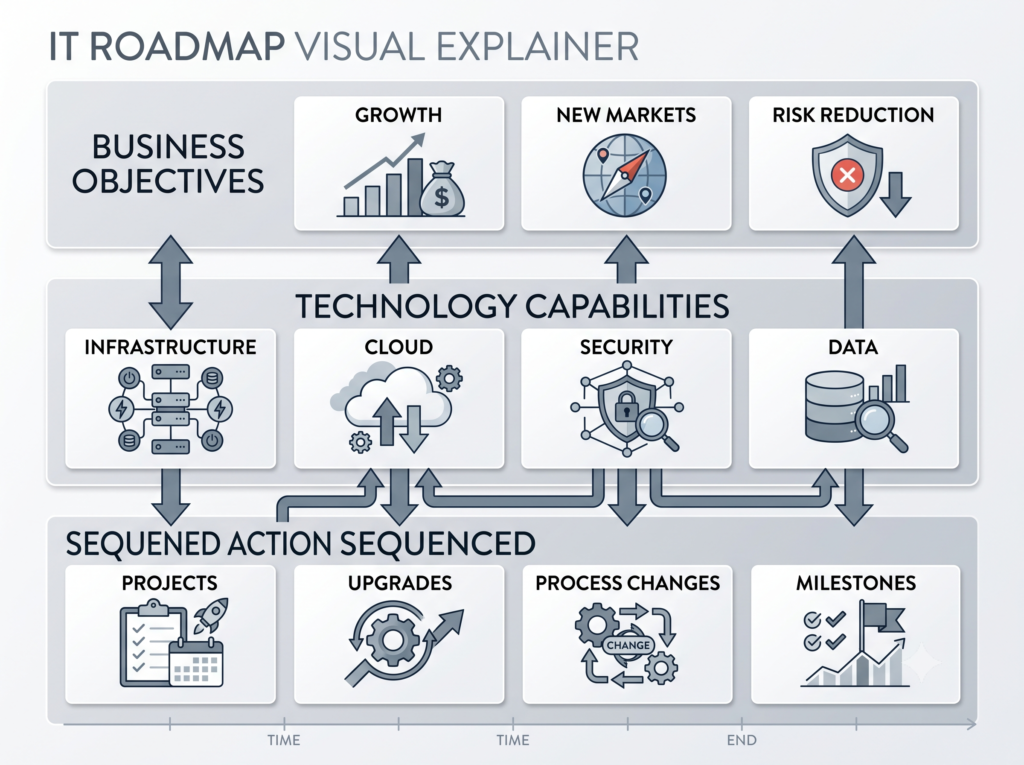
An IT roadmap is more than a list of projects or a vendor catalogue. It connects three layers:
Business objectives – growth targets, risk and resilience goals, experience goals
Technology capabilities – infrastructure and cloud foundation, core applications, security and governance
Sequenced actions – projects, upgrades, and process changes arranged in a realistic order.
When these layers are clear, decisions about tools and platforms are anchored in direction. The roadmap makes it easier to:
Prioritise projects based on business impact.
Coordinate changes across teams.
Justify investments in modernisation and resilience.
How IT roadmaps change day‑to‑day decisions
With a roadmap in place, everyday decisions start to look different:
Tool requests are evaluated against the target architecture, not only local preferences.
Infrastructure changes are planned as part of a modernisation path, not one‑off fixes
Security and resilience work is scheduled intentionally rather than left for “when we have time.
For CEOs and CTOs, this shifts the conversation from “Which tool should we buy next?” to “What environment do we need, and which changes genuinely move us towards it?”
Making the roadmap a living document, not a slide deck
A roadmap has value only if it is used. Effective organisations.
Review the roadmap regularly in joint business, IT sessions.
Update it when major signals change, such as market shifts or significant incidents.
Track progress against outcomes, not just project completion.
When treated as a living document, the roadmap becomes a shared reference point for technology direction—grounding discussions, guiding investments, and reducing the number of surprises.
To see how Infosolic translates this into real change, click “the Case Study” button and explore how we helped a growing organisation move from ad‑hoc IT decisions to a clear, outcome‑driven roadmap.